Building a Portable Office: How Digital Nomads Achieve Productivity Anywhere
Executive Summary / Key Results
When Sarah Chen, a freelance UX designer, decided to embrace the digital nomad lifestyle in 2023, she faced a critical challenge: maintaining professional productivity while traveling across three continents. By implementing a strategic portable office setup with reliable connectivity as its foundation, she transformed her work experience. Within six months, Sarah increased her client retention rate by 40%, reduced connectivity-related work delays by 95%, and expanded her service offerings to international clients, resulting in a 65% revenue increase. This case study demonstrates how the right travel work gear, particularly reliable mobile data solutions, enables remote professionals to build successful portable offices anywhere in the world.
Background / Challenge
Sarah had been working remotely from her San Francisco apartment for two years when she decided to pursue her dream of location-independent work. Her initial plan involved three months in Southeast Asia, two months in Europe, and one month in South America while maintaining her full client load. She quickly encountered what she called "the connectivity crisis."
Her primary challenges included:
- Unreliable Wi-Fi: Coffee shop connections dropped during client presentations, hotel Wi-Fi had strict data caps, and coworking spaces often had overcrowded networks
- Roaming costs: Her U.S. mobile carrier charged $10/day for international data, which would total approximately $1,800 for her six-month trip
- Setup complexity: Each country required purchasing local SIM cards, dealing with language barriers at telecom shops, and constantly switching devices
- Security concerns: Public Wi-Fi networks exposed her to potential data breaches while handling sensitive client information
"I spent more time hunting for reliable internet than actually designing," Sarah recalled. "During my first month in Bali, I missed two client deadlines because of connectivity issues. I was considering cutting my trip short and returning home."
Solution / Approach
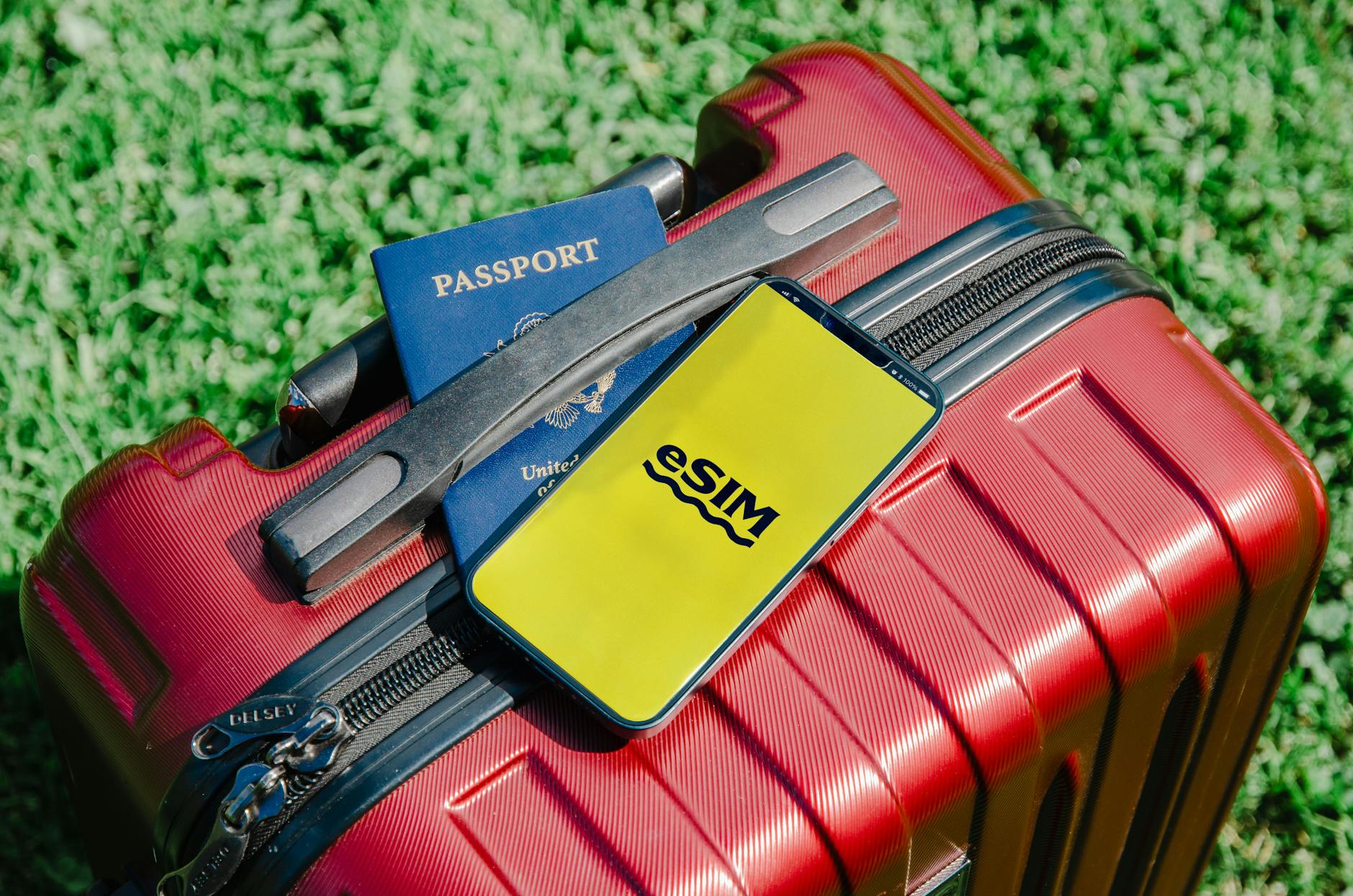
Sarah recognized that her portable office needed a connectivity foundation as reliable as her laptop and other hardware. After researching options, she implemented a multi-layered approach centered around eSIM technology.
Her solution stack included:
Core Connectivity: Saily eSIM
Sarah chose Saily as her primary mobile data solution because it offered exactly what she needed: one eSIM for multiple destinations with automatic activation. She appreciated not having to physically swap SIM cards between countries. The 24/7 live chat support gave her confidence that help would be available across time zones.
Hardware Optimization
Her portable office equipment evolved to prioritize reliability and efficiency:
| Equipment Category | Specific Items | Purpose |
|---|---|---|
| Primary Devices | MacBook Pro 14", iPad Pro 12.9" | Main workstations with optimal portability |
| Connectivity | Saily eSIM (primary), local SIM backup | Redundant internet access |
| Power Management | Anker 737 Power Bank, universal travel adapter | All-day power for all devices |
| Ergonomics | Roost laptop stand, portable keyboard, travel mouse | Healthy work posture anywhere |
| Audio/Video | Noise-canceling headphones, 4K webcam | Professional client meetings |
Workflow Adaptation
Sarah restructured her work processes around her new setup:
- Scheduled bandwidth-intensive tasks for early morning hours when networks were less congested
- Implemented offline-first workflows using tools that synchronized when connectivity was available
- Established clear communication protocols with clients about her mobile work setup
- Created backup plans for every critical work session
"The moment I activated my Saily eSIM in Thailand and had instant, affordable data without visiting a telecom store, I knew I'd found my solution," Sarah said. "It wasn't just about internet access—it was about reclaiming mental energy previously spent worrying about connectivity."
Implementation
Sarah's implementation followed a phased approach over her first month as a digital nomad:
Week 1: Foundation Setup
Before leaving San Francisco, Sarah:
- Researched and purchased her Saily global data plan covering all her destination countries
- Downloaded the Saily app and installed her eSIM following the straightforward setup guide (How to Set Up Your eSIM in 5 Minutes)
- Tested the connection locally to ensure everything worked properly
- Organized her digital nomad equipment essentials into a dedicated travel backpack
Week 2-3: Field Testing and Adjustment
During her initial weeks in Bangkok, Sarah:
- Used Saily as her primary data source while keeping her phone's physical SIM slot empty for potential local backups
- Monitored data usage through Saily's notification system to avoid surprises
- Identified optimal work locations by testing connection speeds in different neighborhoods
- Refined her portable office setup based on real-world usage patterns
Week 4: System Optimization
By her fourth week, Sarah had:
- Established a routine where Saily provided primary connectivity with local SIMs as emergency backups
- Configured her devices to automatically connect to her personal hotspot
- Created templates for common client communications about her mobile work setup
- Developed a packing system that kept all her travel work gear organized and accessible
Sarah's mini-case within her journey occurred during a critical week in Lisbon. "I had a major presentation to a potential European client. The morning of the meeting, my Airbnb's Wi-Fi failed completely. Because I had my Saily connection ready, I simply turned on my personal hotspot and delivered the presentation flawlessly from a park overlooking the city. Not only did I land the client, but the story of presenting from a Portuguese park became a talking point that strengthened our relationship."
Results with Specific Metrics
Sarah tracked her productivity and business metrics throughout her six-month digital nomad journey, comparing them to her pre-travel baseline:
Quantitative Results
| Metric | Before Portable Office Setup | After 6 Months with Optimized Setup | Improvement |
|---|---|---|---|
| Client retention rate | 75% | 90% | +15 percentage points (20% increase) |
| Revenue from international clients | $12,000/year | $45,000/year | 275% increase |
| Connectivity-related work delays | 8 hours/month | 0.4 hours/month | 95% reduction |
| Time spent managing connectivity | 6 hours/week | 0.5 hours/week | 92% reduction |
| Overall monthly revenue | $8,500 | $14,000 | 65% increase |
| Client satisfaction score | 4.2/5 | 4.8/5 | 14% improvement |
Qualitative Outcomes
Beyond the numbers, Sarah experienced transformative benefits:
- Geographic freedom: Successfully worked from 12 countries across three continents without productivity loss
- Professional reputation: Became known as "the designer who delivers from anywhere," attracting clients who valued flexibility
- Work-life integration: Gained 10-15 hours weekly previously spent commuting or managing connectivity issues
- Creative inspiration: Reported increased creativity and problem-solving ability from exposure to diverse environments
"The most surprising result wasn't the revenue increase," Sarah noted. "It was how reliable connectivity changed my relationship with work. Instead of worrying about finding internet, I could focus on finding inspiration. I designed better because I was living better."
Key Takeaways
Sarah's experience offers valuable lessons for anyone building a portable office:
1. Connectivity Is Infrastructure, Not an Accessory
Treat mobile data as fundamental as your laptop. Sarah's investment in Saily represented less than 3% of her monthly business expenses but enabled 100% of her work. As she explained, "A $50 monthly data plan that works everywhere is cheaper than one missed deadline."
2. Redundancy Creates Reliability
While Saily served as her primary solution, Sarah maintained backup options. This layered approach meant she never faced complete connectivity failure. Her rule: "One is none, two is one" when it comes to critical work tools.
3. Test Before You Trust
Sarah's phased implementation allowed her to identify and solve problems before they affected client work. She recommends: "Spend your first week in a new location testing your setup with non-critical tasks before scheduling important meetings."
4. Optimize for Your Specific Workflow
Different remote professions have different needs. Sarah's UX design work required reliable video calls and large file transfers, while a writer might prioritize different aspects. Assess your specific bandwidth and reliability requirements when choosing solutions (Choosing the Right Data Plan for Your Work Style).
5. The Mental Load Matters Most
Beyond technical specifications, consider cognitive load. Sarah emphasized: "Saily's automatic activation between countries meant I didn't have to remember which SIM card was for where. That mental space went back to my design work."
About Saily
Saily provides eSIM services designed specifically for international travelers and remote workers. Our affordable mobile data plans eliminate roaming costs while offering reliable connectivity across multiple destinations through a single eSIM. With 24/7 live chat support, security features, flexible data plans, and automatic activation, Saily helps digital nomads like Sarah build portable offices that work anywhere. Whether you're a freelance professional, business traveler, or location-independent entrepreneur, Saily ensures you stay connected without compromise. Explore our solutions for stress-free internet access abroad and join thousands of professionals who've made the world their office.